Dinevate vs Menufy
Dinevate is one system: your website, online ordering, your own branded app and your front counter run on one menu, one order pipeline and one customer record. Onboarding is a set $499 one time, then an ongoing arrangement built around your volume, with no contract.
Every category its own page
Instead of one long menu to scroll, each category opens as its own page, ready before the guest taps it, and Google can index each one.
Chain-app ordering depth
Half-and-half pizzas with visual placement, topping prices that follow the size, and Light, Normal, Extra or On the Side on individual ingredients.
Articles on your own domain
We write full local articles from your live menu, publish them on your own website, and report what each one earns in Search Console.
Priced around your volume
Menufy is a flat monthly plan; Dinevate is $499 once to launch, then an ongoing arrangement, with reservations, Voice AI, Catering Pro and Social Media Pro as add-ons.
This is the ordering your guests get
Not a mockup — your menu, on your own domain and in your own branded app, with the checkout guests already know from the national chains.
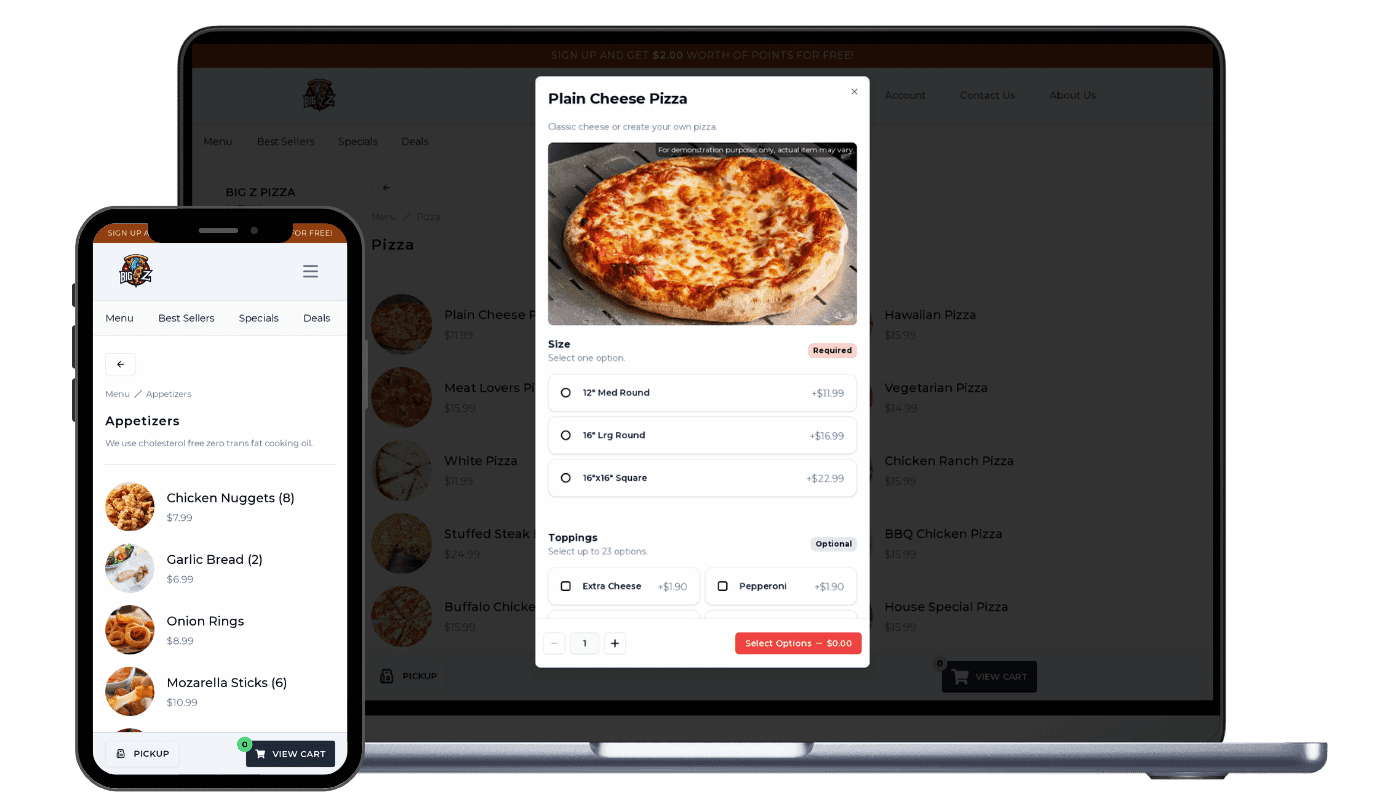
- Its own page, not a scroll position
- Note the “Menu / Pizza” breadcrumb. Each category is a routed, prefetched page — so it opens instantly and Google can index it on its own.
- Options built for real menus
- Size marked Required, Toppings marked Optional, each with its own price. Half-and-half placement and size-aware topping pricing work the same way.
- The same thing on a phone
- The phone is the primary layout, not a shrunken desktop — and the same menu drives your branded app, the AI phone line and your register.
Choose Dinevate if…
You want the website, the ordering, your own app and your front counter to be one system on your own domain, with ordering deep enough to build a half-and-half pizza properly and real local articles published under your name.
Choose Menufy if…
What you are buying is a single flat monthly line for a website and an ordering page, and you do not need a phone line, a guest list across channels, or content on your own site.
Dinevate vs Menufy at a glance
| Feature | Dinevate | Menufy |
|---|---|---|
| Where your orders come from | Website, your own branded app and your front counter, all one system | A website and an online ordering page |
| How your menu is laid out | Each category opens as its own page, loaded before the guest taps it | One long ordering page the guest scrolls through |
| Finding a dish quickly | Guests can search your whole menu by dish name, description or category | No search box on the ordering page, on the two sites we checked |
| Building the order | Half-and-half pizzas, toppings priced by size, Light / Extra / On the Side | Tapping a dish asks pickup or delivery before you can build it |
| Saving a card for next time | Order as a guest with no account; saved cards and Apple Pay where supported | Saving a card means signing in with Facebook or Google |
| When the phone rings | An AI add-on answers, takes the order and files it with the rest | The plan covers your website and ordering page, not your phone line |
| Your customer list | Web, app, phone and counter guests in one list you can export any time | The guests who ordered through your online ordering page |
| Getting found locally | Real articles about your food and your town, on your own website | Restaurant sites run two or three pages; local pages sit on Menufy's site |
| What it costs | $499 once to get set up, then an ongoing arrangement, no contract | $149/month on a 12-month agreement, or $179/month month-to-month |
Menufy details are general and may change — check the vendor's site for current specifics. Last updated 2026-08-26.
What is Menufy?
Menufy is a restaurant website and online ordering provider on a flat monthly plan — $149/month on a 12-month agreement, or $179/month month-to-month — with no per-order commission charged to the restaurant and no feature gating between the two plans; the annual plan bundles a tablet and a printer, and the card processing rate is not published on its site. Ordering runs on the restaurant's own domain, and checkout accepts Apple Pay, Google Pay, PayPal and Venmo — but that is the whole product: a website and an ordering page, with no phone line, no branded app and no counter on the same system. On the two live Menufy ordering sites we audited in 2026 — one with 8 categories, one with 15 — there was no search field anywhere on the ordering page (we enumerated every input in the light DOM and every shadow root; the 15-category menu ran 8,767 pixels tall), and tapping an item opened a "Pick an Order Type" step before it could be configured. Menufy's own help centre states that saving a card requires logging in through Facebook or Google.
What is Dinevate?
Most vendors sell a website and an ordering page, then integrate a phone product, an app and a register on top. In Dinevate they were never separate. Website checkout, the branded mobile app, the AI phone agent and the in-store register all call the same order function, so the tax logic, discount validation, duplicate guard, confirmation email and POS hand-off are identical no matter which door the order came through — and every one of them lands on the same kitchen screen, with no separate "AI orders" inbox to check. One menu record feeds the website, the app, what the phone AI says out loud, the register and Google's food-ordering feeds, so you price a dish once. The customer record is shared too: the phone agent recognises a returning caller by number against the same account the website uses, and a first-time caller becomes a customer record with the order attached — which is also your email-marketing audience. Because the channel is stamped on every order, your dashboard draws one "How Customers Order" breakdown across website, app, phone and counter. Commercially: onboarding is $499, one time, a set price, covering your website, online ordering, loyalty, local SEO, email marketing and the Order Manager tablet (loaned, and it remains Dinevate property), with your branded iPhone and Android app included in the plan at no separate price. After launch you are on an ongoing arrangement — either a per-order service fee or a flat monthly, whichever fits your restaurant — with no contract and no cancellation penalty. Four products are add-ons with their own subscriptions: reservations, Dinevate Voice AI, Catering Pro and Social Media Pro. Dinevate Delivery is not an add-on and not a subscription — it is the delivery itself, paid per delivery, only when you use it.
Why restaurants choose Dinevate over Menufy
Four doors, one order pipeline
A website order, an app order, a phone order the AI took and a walk-in rung up at the counter are the same order in the same system — same menu, same customer, same kitchen screen. That is why your dashboard can show one breakdown of how your customers order across website, app, phone and counter, while a vendor running separate products has nothing to join together. Menufy's package is a website and an ordering page, so the call that comes in at 7pm is not a record anywhere.
Ordering built like a national chain's app
Each menu category opens as its own page, ready before the guest taps it and findable in Google on its own, instead of one long menu document to scroll. Guests can search the whole menu by dish name, description or category; on the two Menufy sites we checked in 2026 there was no search box on the ordering page, and tapping an item asked pickup or delivery before it could be configured. And the item screen goes deep: half-and-half pizzas with the toppings placed visually, topping prices that follow the size, and Light, Normal, Extra or On the Side on individual ingredients.
Articles on your own website, not a directory beside 22 competitors
Menufy restaurant sites run two or three pages, and the local content Menufy does publish lives on order.menufy.com — its Kansas City pizza page lists 22 competing pizzerias next to you. Dinevate writes 10 to 16 full local articles for a single-location restaurant from your live menu, your real addresses and your real hours, and publishes them on your own domain, then reports what each one earns in Search Console. The cap is on purpose: on 5 August 2026 we deleted 8,252 of our own low-value pages across 47 restaurants after measuring that they had earned no clicks in 90 days.
Priced around your restaurant, and said out loud
Menufy is $149/month on a 12-month agreement or $179/month month-to-month, and its card processing rate is not published on its site. Dinevate states the fixed number openly: $499 to get set up, one time, the same for everyone — covering your website, online ordering, loyalty, local SEO, email marketing and the loaned Order Manager tablet, with your branded iPhone and Android app included at no separate price. After that you are on an ongoing arrangement, a per-order service fee or a flat monthly built around your volume rather than a tier you squeeze into, with no contract — and four add-ons are named and priced separately: reservations, Dinevate Voice AI, Catering Pro and Social Media Pro.
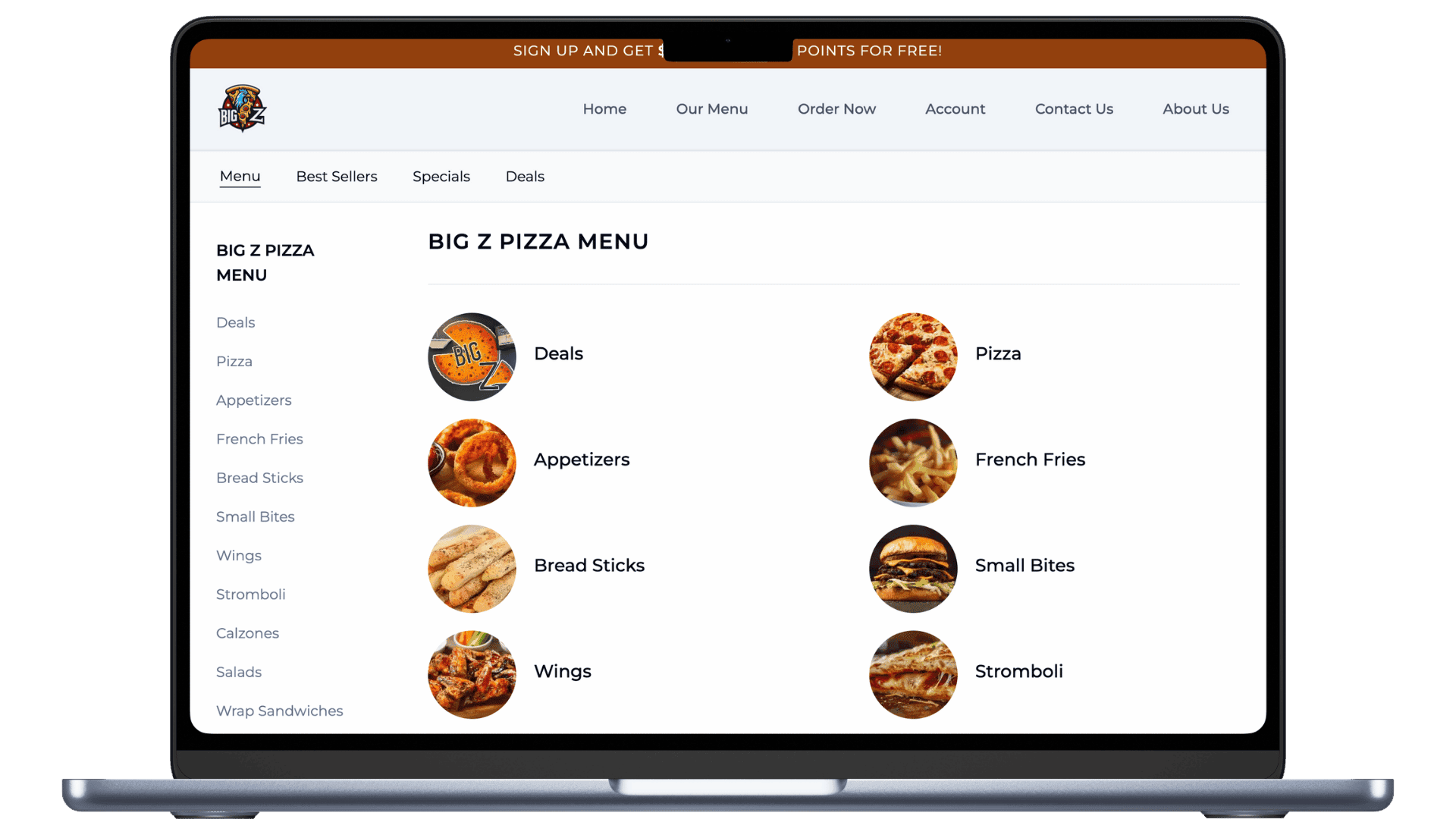
Most vendors sell a website and an ordering page, then bolt on the rest. In Dinevate they were never separate.
Your website, your online ordering, your branded app, the AI that answers your phone and the register at your counter all run on one menu, one order pipeline and one customer record. That is not a longer feature list — it is a different architecture, and it is what a website-plus-ordering vendor cannot copy without rebuilding.
One order pipeline, whichever door it came through
A website order, an order from your branded app, an order the AI took on the phone, and an order rung up at the counter are the same kind of order in the same system — same tax logic, same discounts, same duplicate protection, same confirmation. Nothing drifts between channels because there is no second channel to drift from.
One screen in the kitchen
Every order lands on the same Order Manager tablet and the same printer flow. A phone order looks exactly like a website order to your staff. There is no separate inbox to remember to check.
One menu behind every surface
The same menu drives your website, your app, what the AI says on the phone, the in-store register, and your Google food-ordering feeds. You price a dish once and it is priced everywhere.
One customer, however they reached you
When a regular calls, the AI recognizes the number against the same customer account the website uses — their name, their saved addresses. A caller who has never touched your website becomes a customer record with the order attached, and that record is the audience your email marketing already uses.
One list for reservations, one pipeline for catering
Bookings from the website, the app, the phone and the walk-in podium are a single list synced to the tablet. Catering inquiries taken on a call land in the same pipeline as the ones from your website form.
One chart a bolted-together stack cannot draw
Because the channel is recorded on every order, your dashboard shows one breakdown of how your customers actually order — website, app, phone, in-store — side by side. Vendors running separate systems for each channel have no single place that number exists.
And the ordering itself is built like a chain app
This is the part guests feel. Your regulars already know how the big chains order — Dinevate holds your menu to that standard.
Each category is its own page, not a scroll position
Most ordering platforms render your whole menu as one long document and give guests a jump-link to scroll inside it. Dinevate gives every category its own page, prefetched the moment the menu loads so it opens instantly — and individually indexable by Google. It behaves like an app and it ranks like a website.
Customization built for real menus
Half-and-half pizza with visual placement on the pie. Topping prices that follow the size automatically. Light, Normal, Extra or On the Side per ingredient. Required picks, pick-three budgets, nested sub-groups, and “these come included — tap to remove what you don’t want.”
Nobody gets stuck at the Add button
Miss a required choice and the button tells you so, then scrolls you straight to the group you missed and highlights it. The running price updates live on the button as you build the item.
Suggestions from your own order history
After an item is added, the suggestions that appear are computed from what your customers actually buy together, refreshed weekly — not a generic upsell list. Popular Combinations applies an entire proven build, every option included, in one tap.
Reorder that actually rebuilds the order
One tap rebuilds a past order with every modifier and special request intact. Favorites remember the exact options, not just the dish.
A checkout that does not lose people
Apple Pay and Google Pay where the processor supports them, saved cards, and guest checkout with no account wall. Four steps that collapse as you finish them, the order summary first on a phone, address autocomplete with a confirmation step, and honest longer wait times shown before the guest commits.
Everything Dinevate runs for you
Included
Covered by your $499 onboarding and your ongoing arrangement
Online Ordering
A fast restaurant online ordering system for pickup, delivery, Apple Pay, Google Pay, and direct customer data.
Restaurant Mobile App
Your own branded iPhone and Android app with full ordering, one-tap reorder, loyalty, wallet, and saved cards.
Restaurant Website
A restaurant website builder with online ordering, local SEO pages, menus, hours, photos, and direct checkout.
Email Marketing
Restaurant email marketing for birthdays, offers, order follow-ups, and win-back campaigns.
Restaurant SEO & Local Marketing
Restaurant SEO and local marketing that helps hungry customers find you on Google.
Loyalty & Rewards
A restaurant loyalty program with points, rewards, offers, and customer accounts.
Order Manager
A tablet order manager for accepting, tracking, and handling restaurant orders from one place.
Delivery Manager App
Delivery management tools for drivers, tracking, service areas, and restaurant delivery operations.
Menu management
One menu record feeding every surface — sizes, half-and-half, nested option groups, time-of-day categories.
Customer records you can export
Every guest — web, app, phone, walk-in — in one list with their order history, exportable to CSV whenever you want.
Google Search Console setup and reporting
We register your domain, verify it, submit your sitemap, then report clicks, impressions and position back to you per page.
Google Business Profile sync
A daily job keeps your website, menu link and “Order online” button pointed at you — and reclaims that button when a marketplace has taken it.
Wallet, gift cards and promo codes
Stored balance with cashback, gift cards redeemed by code, and promo codes — all available at the same checkout.
Merchant dashboard
Earnings, completed orders, average ticket, how customers order by channel, menu insights, statements and disputes.
In-store register and kitchen display
Available when you want it: floor map, tabs, terminal payments, staff logins with role permissions, and an end-of-day drawer count.
Order printing built for a real kitchen
Multiple printers with per-station routing, your logo, and a lead time so scheduled orders print just before they are needed.
Add-ons
Their own subscription — never inside the $499
Reservations
Website, phone, app and walk-in bookings in one list, synced to the tablet.
Dinevate Voice AI
AI phone ordering for restaurants that answers calls, takes orders, and handles reservations.
Dinevate Catering Pro
Catering software for estimates, deposits, invoices, and large restaurant orders.
Social Media Manager
Restaurant social media tools for posts, scheduling, reviews, and local customer engagement.
Dinevate Delivery — not an add-on
It is the delivery itself, not a subscription. We dispatch the best-rated driver in your area, 100% of the tip goes to the driver, and the fee depends on your area and the distance. You pay per delivery, only when you use it.
How Dinevate Delivery worksFrequently asked questions
- Is Dinevate a good alternative to Menufy?
- Yes, and for a structural reason rather than a feature count. Menufy sells a website and an ordering page; Dinevate is one system across your website, your own branded app and your front counter, with an AI phone line available as an add-on, all running on one menu, one order pipeline and one customer list. The ordering flow goes deeper too: each category is its own page rather than a jump inside one long menu, pizzas can be built half-and-half, topping prices follow the size, and one tap on a past order rebuilds it with every option intact. And we publish real local articles on your own website rather than directory pages on ours.
- What does Menufy cost in 2026?
- Menufy lists $149/month on a 12-month agreement, or $179/month month-to-month, with no per-order commission charged to the restaurant and no feature gating between the plans; the annual plan bundles a tablet and a printer. Its card processing rate is not published anywhere on its site, so ask for it in writing. Menufy's own pricing page is the place to confirm those numbers before you sign. Dinevate's fixed number is stated right here: $499 to get set up, one time, the same for everyone, then an ongoing arrangement quoted on your volume, with no contract.
- What does Dinevate cost, and is there a monthly bill?
- Getting set up is $499, one time — a set price, the same for everyone — and it covers your website, online ordering, loyalty, local SEO, email marketing and the Order Manager tablet, which is loaned and remains Dinevate property. Your branded iPhone and Android app is included in the plan at no separate price. After launch you are on an ongoing arrangement: either a per-order service fee or a flat monthly, whichever fits your restaurant better. There is no contract and no cancellation penalty, but there is an ongoing cost, and we would rather tell you that here than in month two. Four products are separate add-ons — reservations, Dinevate Voice AI, Catering Pro and Social Media Pro — and a few one-time items sit outside the $499: Pro Photo Service $99, receipt printer $299 each, kitchen display $249 each, and optional SEO tier upgrades.
- Do my guests need a Facebook or Google account to save a card?
- Not on Dinevate. On Menufy, saving a card requires logging in through Facebook or Google — that is from their own help centre. On Dinevate a guest can order with no account at all, and signing in is offered as a convenience rather than a gate. Saved cards are supported, and Apple Pay and Google Pay are available at checkout, with Apple Pay availability depending on how your payment processor is set up. Returning guests get a "Your Favorites & Recent Orders" card with one-tap reorder that rebuilds a past order including every option and any special request.
- Can Dinevate answer my restaurant's phone?
- Dinevate Voice AI is an add-on with its own pricing — a commission on the orders it takes plus a $200/month account minimum — and it is not part of the $499. When it is switched on it answers your line around the clock in English, takes the whole order from your real menu with sizes and modifiers, answers menu questions, books reservations where you have enabled them, captures catering leads and transfers to a person when asked. Card payment is handled by a secure link texted to the caller rather than read out over the phone. The order files into the same pipeline as your website orders and lands on the same kitchen screen, and you get a full transcript of every call.
- How is Dinevate's menu different from a Menufy ordering page?
- Architecture, not decoration. On the two live Menufy sites we audited in 2026 the menu renders as one continuous page — the 15-category one ran 8,767 pixels tall — with no search field anywhere on it, and tapping an item opened a "Pick an Order Type" step before it could be configured. On Dinevate each category is its own page, loaded before the guest taps it, cached and findable in Google on its own, with search over dish names, descriptions and category names on the menu index and four destinations across the top: Menu, Best Sellers, Specials and Deals. Best Sellers is built from real order counts and hides itself until a restaurant has enough history to be honest about it.